
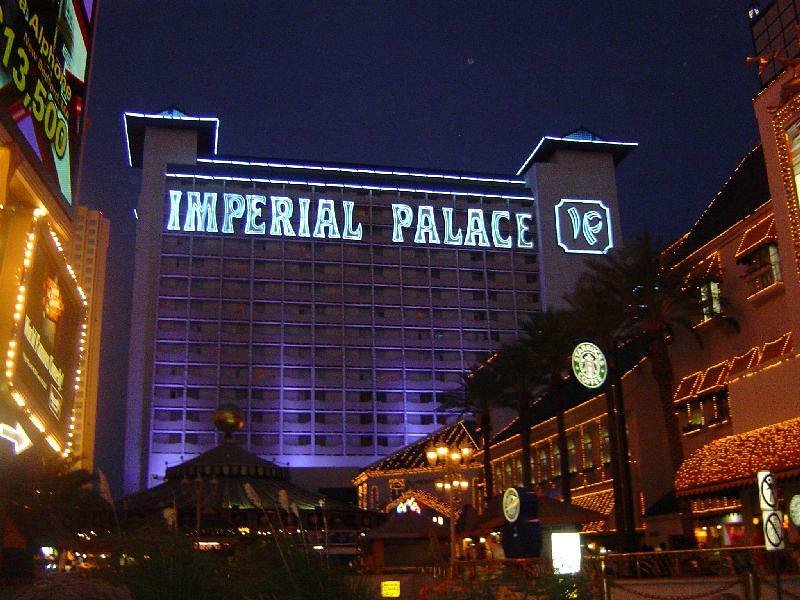
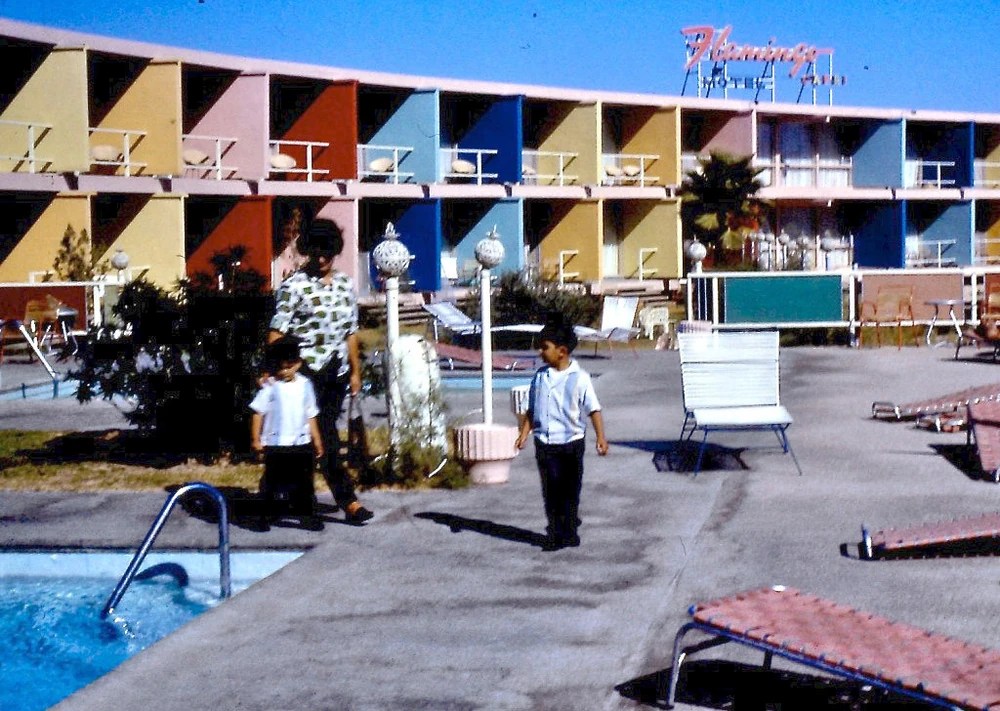
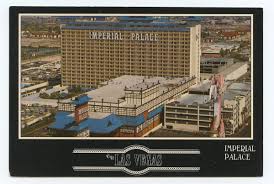
The Imperial Palace was originally opened as the Flamingo Capri in 1959 as a 180-room motel. Ralph Engelstad purchased the property in 1971, added a casino in 1972, and renamed it the Imperial Palace in 1979 when a new casino facility opened. Engelstad expanded the resort with additional hotel towers from 1982 to 1987, making it one of the largest hotels in the world with 2,637 rooms. Engelstad died in 2002 and operations were taken over by a group including his wife. Harrah’s
Entertainment purchased the Imperial Palace in 2005 for $370 million and considered partial or complete demolition before deciding on a renovation. The resort was renamed as The Quad in 2012 and then as The Linq in 2014 after a $223 million renovation. The Linq Promenade, with the High Roller Ferris wheel, was opened in 2013 and the resort was renamed to match the promenade.
The transformation of the Flamingo Capri to the Imperial Palace took place on November 1st, 1979. The grand opening of the new casino building marked the start of
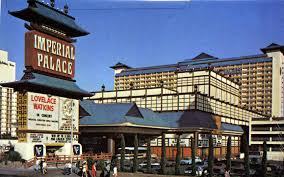
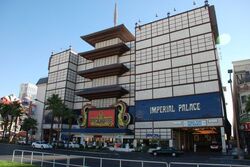
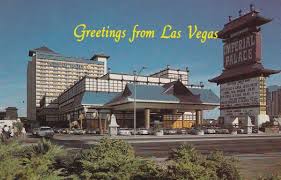
demolition for the old Flamingo Capri casino, making way for the entrance of the Imperial Palace. The number of employees skyrocketed to a thousand, with Merlin J. Barth as the resort’s architect. He designed the resort with an Asian palace theme, which was unique for the Strip and garnered attention for its distinctiveness. Barth incorporated Japanese blue tile for the roof,
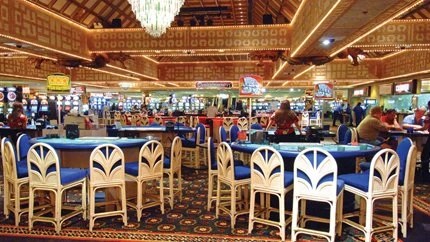
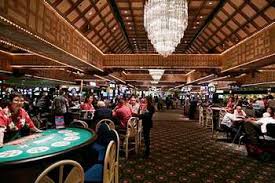
inspired by Japanese temples, and the interior of the resort echoed the Oriental theme with carved dragons and giant wind chime chandeliers. Throughout its history, the Imperial Palace caters to a middle-class and value-conscious clientele, with high occupancy rates due to its location on the Strip and low room rates, despite minimal marketing efforts.
The resort boasted a four-story shopping arcade, the Court of a Thousand Treasures, overlooking the east end of the casino with 60 stores. The Auto Collections opened in 1981 on the fifth floor of a new parking garage. In August 1982, a 650-room hotel tower was added, increasing the room count to over 1500. The shopping arcade also housed the free Imperial Palace School of Gaming, which
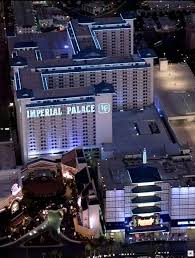
taught gamblers how to play and operated as a mini casino overlooking the main casino floor. The resort served as the starting and finishing location of the annual Imperial Palace Antique Auto Run during the 80s, and the parking garage was expanded in 1985 to include more than 1000 additional parking spaces. A 560-room hotel addition was completed in 1986, making the Imperial Palace the 7th largest hotel in the world with over 2200 employees. The casino was expanded by 15,000 square feet, and the convention facilities were increased to 30,000 sq ft. A final hotel tower with 19 stories and 547 rooms was completed in July 1987, bringing the room count to 2637.
The resort won several awards for its efforts in hiring disabled individuals, twice being named “Employer of the Year” by the Governor’s Committee for the Handicapped and once as “National Employer of the Year” by the President’s Committee on Status of People with Disabilities. The resort also accommodated for hearing-impaired audience members with listening devices in the
showroom.
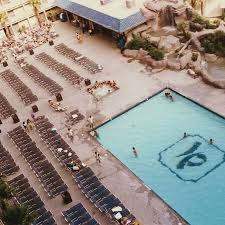
In 1987, a three-phase expansion began and was concluded in July 1989. The expansion included an Olympic-size swimming pool, a heated spa, and a poolside bar. The final phase consisted of a race and sportsbook, and a fitness center, extending the resort to the sidewalk along Las Vegas Boulevard. In September 1989, the sportsbook was completed, and in 1991, the Imperial Palace became the first casino in Las Vegas to offer a drive-through option for sports betting. The drive-through sportsbook became popular among customers and was known for offering more futures and proposition wagers than any other Las Vegas sportsbook in the 90s.
The resort also launched a weekly series of Hawaiian Hot Luau parties in the early 90s, offering a buffet of Asian food and hula dancers and fire eaters performances. In 1993, a medical center was added for employees, their families, and tourists. By the end of the decade, the resort partnered with Reno Air to provide baggage check-in for guests ahead of their outgoing flights.
The Flamingo Capri motel was built in 1959 with 180 rooms and located directly north of the Flamingo Hotel and Casino. Bill Capri, an employee of the Flamingo, was one of its owners. Ralph Engelstad bought the motel in 1971 and added a casino the following year. In 1974, four motel buildings were relocated and added to Engelstad’s Kona Kai motel, and a three-story wing and northern addition were added to the Flamingo Capri. The property became part of the Best Western hotel chain in 1976, and in 1977 a 19-story tower, the Imperial Palace Tower, was added. The expansion included a new casino building and a showroom, and there were plans to eventually rename the property as the Imperial Palace, which it became in 1979 after the casino opened.
The Imperial Palace, originally the Flamingo Capri motel, was the subject of several controversies throughout its history. In 1984, a couple staying at the hotel sued the Imperial Palace for security negligence, and the wife accused the resort of destroying records that were sought for the lawsuit. Casino executives later admitted to the destruction of these records. The resort was also accused of
sexual and religious discrimination in several lawsuits filed in the mid-1980s. In 1988, the Nevada Gaming Control Board found that the resort’s owner, Ralph Engelstad, had a “war room” with a collection of Nazi memorabilia and that he hosted Nazi-themed parties. Engelstad faced a $1.5 million fine and possible revocation of his gaming license, but eventually agreed to pay the fine. In 1997, the Equal Employment Opportunity Commission filed a sex discrimination lawsuit against the Imperial Palace on behalf of six cocktail waitresses who were pregnant and had their hours reduced. The resort reached financial settlements with the women after three years. In 2001, advantage gambler James Grosjean was briefly detained by Imperial Palace security, and he filed and won a lawsuit against the resort for false imprisonment.
The Imperial Palace was a casino and resort located on the Las Vegas Strip in Nevada, United States. It was founded in 1979 by Ralph Engelstad, a billionaire real estate developer from North Dakota. The resort was famous for its unique, imperial-style architecture, which was based on an original idea of Engelstad’s.
Engelstad considered selling the Imperial Palace in the mid-1990s for an estimated $400-$500 million. At that time, the resort occupied 8.5 acres and Engelstad also owned an additional 10 acres behind the property. The casino measured 47,625 square feet and was the 10th largest hotel in the world and the largest privately-owned hotel at that time. In 1997, Engelstad opened a second Imperial Palace in Biloxi, Mississippi.
In 2000, Engelstad announced his plans to retire and sell his properties, and analysts considered Harrah’s Entertainment to be the most likely buyer for the Imperial Palace, given that the company’s Harrah’s Las Vegas resort was located on adjacent property. However, Engelstad passed away in 2002 from lung cancer, and his wife Betty, along with his attorney, accountant, and the property’s general manager, took over operations as co-trustees and there were no immediate plans to sell the property.
In 2003, the Imperial Palace added 600 new slot machines and a monorail station was built connecting it to Harrah’s Las Vegas. In 2004, an escalator fire caused $500,000 in damage, but the property was quickly reopened. In 2005, Harrah’s Entertainment purchased Caesars Entertainment, which included the O’Sheas Casino and the Flamingo, and two months later, Harrah’s announced its plans to purchase the Imperial Palace for $370 million. Harrah’s had long wanted to acquire the property and there was speculation that it would be demolished for a new project.
Harrah’s completed its purchase in December 2005 and announced that the Imperial Palace would remain open while redevelopment options were considered. Harrah’s was renamed as Caesars Entertainment Corporation in 2010, and in 2011, Caesars announced that the Imperial Palace name would be replaced and the property would be renovated. That year, construction began on Project Linq, an outdoor collection of restaurants, bars, and retailers, built between the Imperial Palace and Flamingo. The Imperial Palace’s wedding chapel was among the facilities to receive renovation work, and the resort’s main entrance on Las Vegas Boulevard was closed in 2012 as part of the construction for Project Linq. The Rockhouse bar and nightclub, which had operated at the original entrance for several years, was permanently closed.
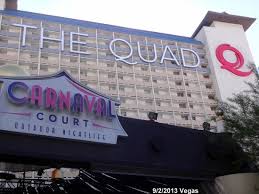
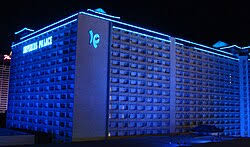
The Quad, formerly known as the Imperial Palace, underwent significant changes in 2012. The name was changed to denote a center of activity, similar to a college quadrangle, and the property was updated with modern designs. The Asian theme was removed and the exterior logo was changed to a giant “Q”. The casino floor received new slot machines, table games, and several new restaurants, including one by Guy Fieri, were added. In 2014, the Quad became part of the Linq retail and entertainment complex and served as the primary entrance. The property still has 2,543 rooms and several restaurants.
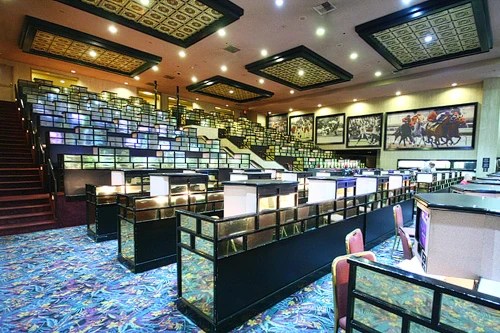
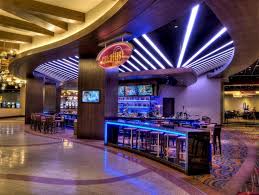
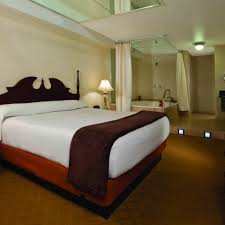
In 2012, Caesars announced that the Imperial Palace would be renamed as The Quad in a $223 million renovation project, to serve as the main entrance for the Linq retail and entertainment complex. The name change to Quad became official in December 2012, and a portion of the renovated casino was opened in March 2013, featuring new restaurants, slot machines, and table games. In July 2014, Caesars renamed the Quad as The Linq Hotel & Casino, matching the newly finished Linq Promenade. The hotel rooms were remodeled and the interior was brightened and opened up for a modern, millennial-targeted design. Self-check in, touchscreens for reservations, and outlets for cellphones and laptops were added. The hotel lobby added a bar and lounge area known as 3535, and final renovations, including a new spa, fitness center, two new pools, and event space, were completed in July 2015. In 2018, the Linq opened an 11,000 sq ft sportsbook, The Book, with 12 rentable areas, a self-serve beer wall, and a food truck, and was intended to serve as a testing ground for new concepts. By 2019, the casino included a video game arcade and 3D LED sculptures, and in 2020, ESPN opened a 6,000 sq ft studio at The Linq as part of its partnership with Caesars Entertainment to provide sports betting information. The Linq currently has a 33,890 sq ft casino and 2,250 rooms.
The Flamingo Capri was built over the Flamingo Wash, which often caused flooding due to its location. The flooding caused damage to the casino and portions of the motel, and required regular rescues by firefighters. Efforts to prevent future flooding were hindered as an underground drainage system could not be installed without weakening the foundation. Despite the transformation into The Linq, the property continued to suffer from flooding and had no plans for structural changes.
The Linq Promenade is a 1,200-foot outdoor entertainment district located at the southern edge of the resort. It features mostly restaurants and nightlife businesses, as well as attractions such as the 550-foot High Roller observation wheel, the 78,000 sq ft Brooklyn Bowl, and Jimmy Kimmel’s Comedy Club. It was developed by Caruso Affiliated and inspired by entertainment and retail complexes in Los Angeles and Manhattan. The Linq Promenade was constructed at a cost of $550 million and celebrated its grand opening in February 2014. Over the years, additional tenants were added, including the Strip’s first In-N-Out Burger, Jimmy Kimmel’s Comedy Club, and the world’s largest ice bar. In 2018, the promenade also added Fly Linq, the first and only zipline on the Strip.
The Auto Collections was a museum that displayed a collection of classic vehicles and was located at the resort until 2017. The museum opened its doors on December 1, 1981, under the name Antique and Classic Auto Collections. It was created with the purpose of showcasing billionaire Ralph Engelstad’s personal car collection, which was worth over $10 million at the time of the opening. The museum was situated on the 5th floor of the resort’s parking garage and was air-conditioned to ensure the proper preservation of the vehicles on display.
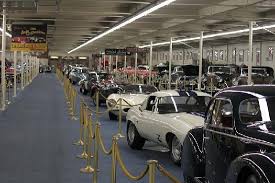
In 1999, the operations of the museum were taken over by Don Williams and Richie Clyne. The Imperial Palace leased the space to Williams and Clyne for just $1 a year due to the popularity of the museum as a tourist attraction. Under their management, the museum began selling and trading its vehicles on February 1, 2000. Williams and Clyne sold off Engelstad’s original car collection and replaced it with new vehicles, with approximately 200 vehicles kept in storage nearby to be rotated in and out of the display. Around half of the vehicles in the collection were owned by Williams and Clyne, and a single mechanic was responsible for maintaining the vehicles on display.
The museum occupied an impressive 125,000 sq ft of space and boasted a collection of vehicles that were once owned by celebrities and state officials. One of the standout vehicles in the collection was a 1939 Chrysler Royal sedan, which Engelstad purchased from Johnny Carson for $1 in 1994. This vehicle was the only one from Engelstad’s personal collection that remained in the museum and was never put up for sale. The collection also featured vehicles such as a 1955 Lincoln Capri convertible owned by Marilyn Monroe and a 1976 Cadillac Eldorado Biarritz owned by Elvis Presley. The museum also displayed vehicles from popular films, including “Eleanor” from Gone in 60 Seconds and a Ford Torino from Starsky & Hutch.
Unfortunately, the Auto Collections closed its doors on December 30, 2017. General Manager and part-owner Rob Williams stated, “It’s time; it’s basically that simple. We’ve had a great run here… It’s just time to close it down and move on to our next endeavors.” Although visitor attendance had slightly declined, it was not the reason for the closure of the museum.
The Imperial Palace in Las Vegas opened its 850-seat showroom in June 1980 and featured the dance show “Bravo Vegas” with owner Phil Engelstad as the executive producer. In May 1983, the popular show “Legends in Concert” opened at the Imperial Palace and would run for nearly 26 years. The show, featuring musical performances by celebrity impersonators, became the third longest-running show on the Las Vegas Strip. In 2009, the show moved to Harrah’s with a new updated venue.
In 2003, the Imperial Palace casino introduced the Legends Pit, named after “Legends in Concert.” The pit featured Dealertainers, celebrity impersonators as blackjack dealers who also performed on a central stage. Some of the impersonated celebrities included Michael Jackson, Cher, Britney Spears, and Buddy Holly. However, Caesars suddenly discontinued the Dealertainer Pit in 2014 without explanation.
From 2009 to 2012, the musical group “Human Nature” performed at the Imperial Palace, which was then renamed the Human Nature Theater. In 2010, Frank Marino began the show “Divas Las Vegas,” in which he impersonated female singers such as Beyoncé and Cher. However, Marino and Caesars mutually agreed to end the show in 2018 after he failed to make a regular donation to the Make-A-Wish Foundation.
Juggler and comedian Jeff Civillico started a show at the Quad in 2012, and the 2,000-seat Brooklyn Bowl venue opened at the Linq Promenade in March 2014 with Elvis Costello and The Roots as the first performers. Magician Mat Franco began his show “Mat Franco: Magic Reinvented Nightly” at the Linq resort in 2015, and the resort’s showroom was named after him in 2017.

The Imperial Palace has appeared in several popular works of film and video games, including “Love Streams” (1984), “Stripper” (1986), “Midnight Run” (1988), “Austin Powers: International Man of Mystery” (1997), and “Grand Theft Auto: San Andreas” (2004). The Linq resort also hosted the film premiere of “Sharknado 5: Global Swarming” in 2017 and was partially used for filming the second season of “Double Shot at Love.”

