
Origins and Early Years

The story begins long before the “Casino Royale” name appeared. The building that houses the current property started life as the Caravan Motor Hotel, which opened in 1964 with 164 rooms, developed by Heers Bros., Inc. on Las Vegas Blvd south.
Later, the adjacent motel and land hosted various motels, small casinos, restaurants and auto-courts: places like Bill’s Place, Matty’s Tropics, the Bon Aire Motor Hotel, the Louigi’s Charcoal Broiler, and a Denny’s restaurant.
In July 1978, the smaller casino called the Nob Hill Casino opened on that site. It was operated by a group that also owned the nearby Holiday Casino (now the Harrah’s Las Vegas).
However, by November 26, 1990, Nob Hill closed when its lease expired.
Re-branding into Casino Royale (1992 Onwards)
On January 1, 1992, the property was reborn as Casino Royale, under the ownership of the Elardi family (who also owned the Frontier at the time). They bought the former Nob Hill and adjacent hotel for about US$17 million.
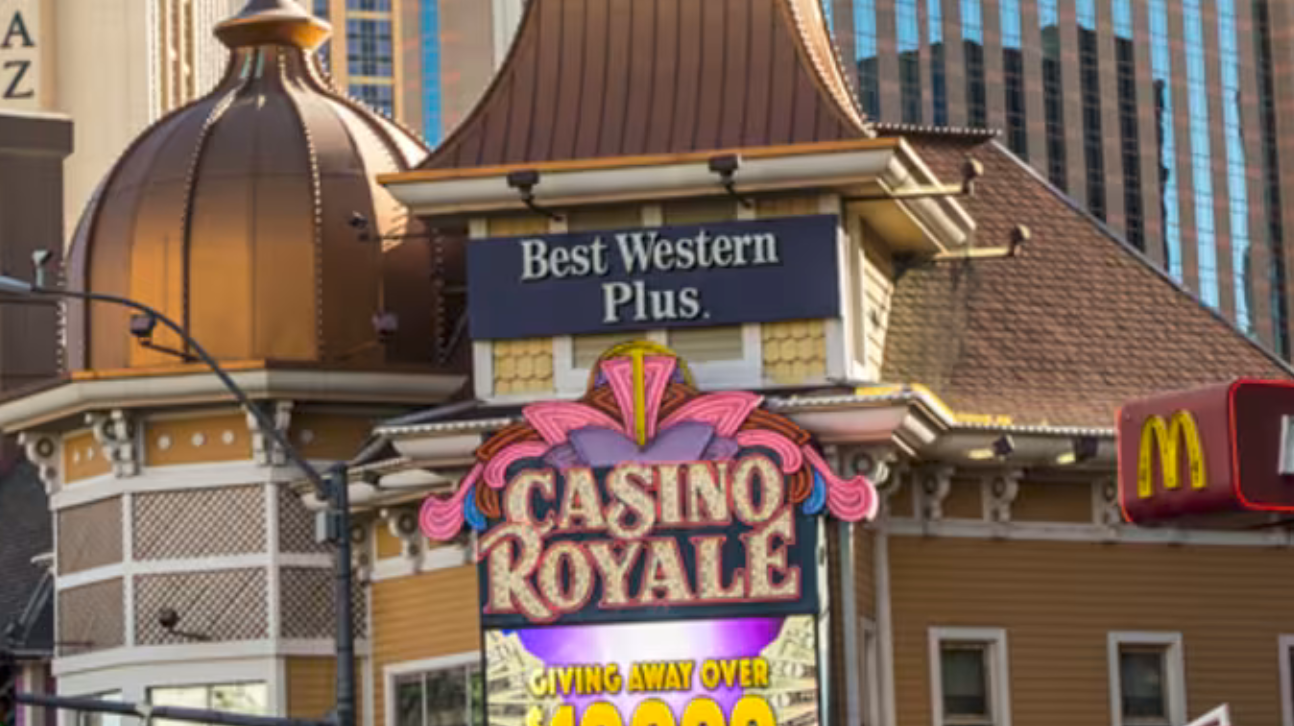
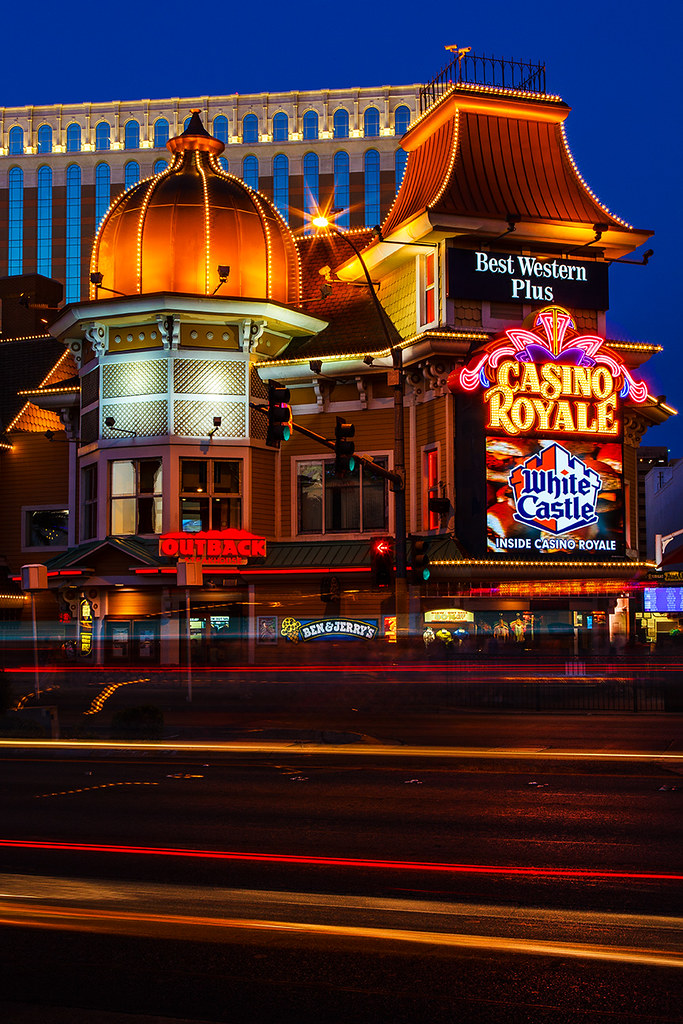
Between 1993–95, the property underwent renovations: the casino expanded to about 19,000 sq ft with added parking garage and a unified “European villa” style façade linking the motel, casino and a Denny’s into one connected property.
From its early “Casino Royale” days, the property carved out a niche as a value-oriented resort on the Strip: low minimums, cheap beer, a smaller footprint compared to mega-resorts.
At opening the casino offered around 10,000 sq ft of gaming with 225 slot machines and 4 table games.
Highlights, Identity & Character
- The façade is quite distinctive for the Strip: more quaint and villa-styled than the glitzy mega-resorts.
- It gained a reputation for being one of the few non-union-represented casinos in Las Vegas for years.
- It was a place with a “locals or value-tourist” vibe — cheaper bets, relaxed atmosphere, not the high-roller showpiece. Reddit users captured that sentiment: “Love those cheap Michelobs.”
“We always find ourselves at Casino Royale for some of our favourite slot machines and drink service.”
Changes in Ownership and Upgrades
In December 2012 the property was re-branded under the Best Western Plus chain (Hotel + Casino).

In 2014 a two-story addition was built (around US$9 million) replacing the Denny’s (which at that time was their highest-volume location) with new amenities: on the ground floor a Walgreens drug-store, on the second floor a new Denny’s, and a White Castle — the chain’s first western U.S. location.
Further, the site was reported to have submitted plans to the Federal Aviation Administration (FAA) to build a 699-ft tall tower on the Casino Royale site. They’ve reportedly until January 21, 2025 to begin construction or let approvals lapse.
Challenges & What’s Next
Analysts note that small-scale resorts like Casino Royale face increasing economic pressure on the Strip, where mega-resorts dominate.
From recent industry coverage, it appears the property may soon be replaced or significantly redeveloped into something much larger. As of the latest, no definitive closing date is confirmed—but the writing may be on the wall.
Why Casino Royale Matters
- It’s a slice of Las Vegas history: the structure traces back to the 1960s–70s era of motels and smaller casinos on the Strip, before the current mega-resort model.
- It offers counterpoint to the ultra-luxury, high-roller resorts: a value-focused, “old-school” vibe that many long-time visitors appreciate.
- Its possible impending redevelopment underscores a major theme in Vegas: the continual evolution, removal, and reinvention of what was once “classic” to make way for tomorrow’s big thing.
If you wander past 3411 Las Vegas Blvd South today, you’ll find Casino Royale still standing – maybe you’ll hear the steady PA announcements. It’s a modest, unflashy presence compared to its neighbors—but with personality and history. Whether it remains in its current form or gives way to a new tower, its legacy as a friendly, value-oriented stop on the Strip is secure.

