
Part 2 of our El Cortez Spotlight series
In the spring of 1945, the desert heat arrived early, pressing down on Fremont Street like a secret. The El Cortez had been open barely four years, and already it was changing hands. The war was nearly over, soldiers were trickling back west, and Las Vegas-still small enough that everyone knew the sheriff by name—-about to inherit something far more complicated than victory.
A group of men from back east, neatly dressed and unnervingly polite, arrived in town with a briefcase full of cash and a simple offer: six hundred thousand dollars for the hotel, no questions asked. In 1945, that was an absurd number-more than the Hoover Dam’s cafeteria budget for an entire year. But when Bugsy Siegel made an offer, you didn’t haggle.
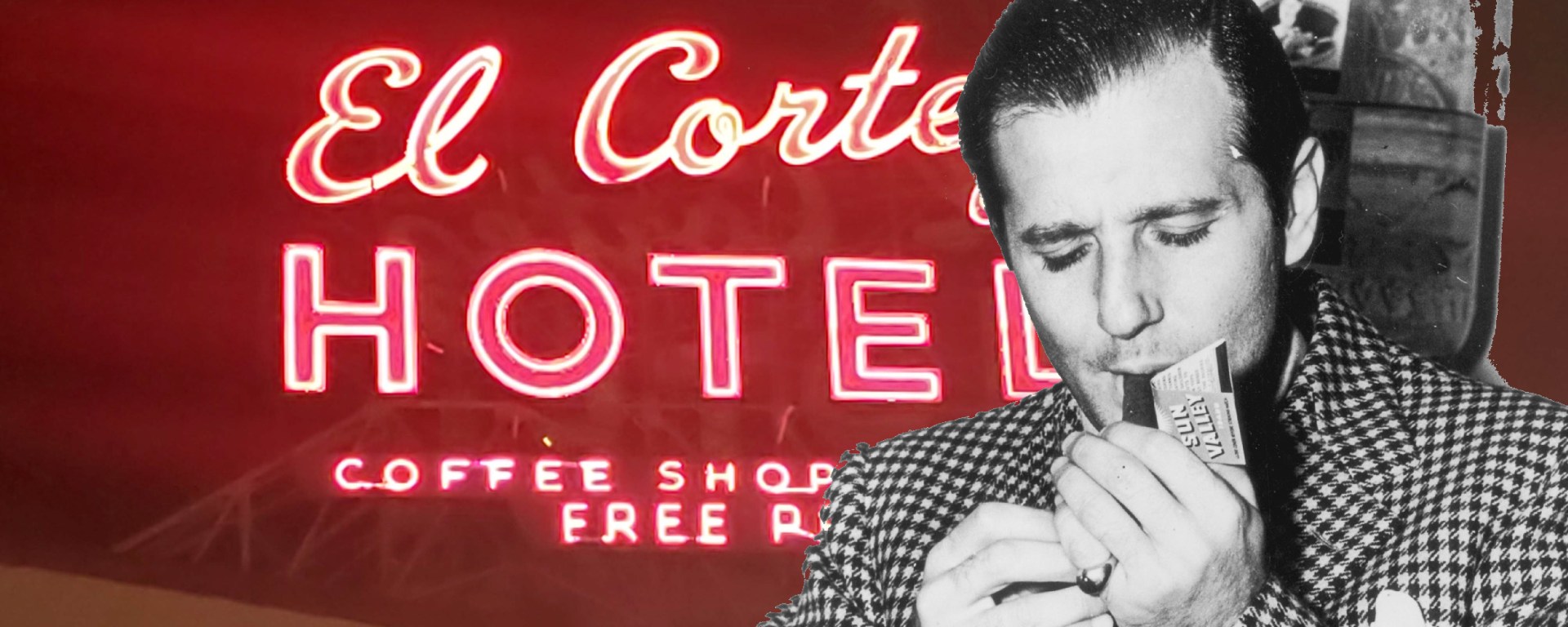
Siegel was charm personified and danger disguised as civility. He had movie-star looks and mobster habits. The papers called him a gangster; he preferred “businessman.” To the townsfolk, he was the most glamorous visitor the desert had ever seen. He arrived in a tan Packard convertible with two bodyguards and a smile that could have melted an arrest warrant.
For Bugsy and his partners-Meyer Lansky, Gus Greenbaum, and Moe Sedway—-Cortez was a test case, a desert laboratory for a grander experiment. They believed Las Vegas could be something new: a western Monaco, a playground for the respectable sinner. In El Cortez, they saw potential-not just for profit, but for proof. If they could make a small hotel work cleanly, efficiently, and with flair, they could scale it.
They were right. Just not for long enough to enjoy it.
The mob didn’t invent Las Vegas, but it gave the place its first personality. Siegel’s group brought discipline to chaos, polish to vice. They tightened accounting, upgraded the bar, ordered new carpets, and insisted on service standards that baffled local staff. They even made dealers wear white shirts and pressed ties-an unheard-of uniform on dusty Fremont Street. For a few glittering months, El Cortez looked less like a frontier casino and more like a Riviera daydream.
But Bugsy was restless. He liked the money, but he loved the stage. Fremont Street, even at its brightest, felt provincial. The Strip—then a dirt highway dotted with billboards and mirages—was the future. He could feel it. The desert was a blank canvas, and he was determined to sign his name in neon.
By 1946, Siegel was spending more time in Los Angeles and less in Las Vegas. He was cultivating investors, pitching an audacious new concept: a resort with gardens, marble floors, fine dining, and fountains. “A palace in the desert,” he called it. The place would become The Flamingo, though at the time, it existed only as a blueprint in his head and a glint in his eye.
When he sold El Cortez back to Houssels and Hicks, he did it with a shrug, as though discarding an old suit. He doubled his money and walked away-an exit so casual it disguised the ambition behind it. The mob had learned what it needed to learn: how to make gambling feel glamorous, and how to hide structure beneath sin.
By the time the Flamingo opened in 1946, the Strip had begun its slow rebellion against Fremont Street. Downtown was practical, close-knit, and vaguely domestic. The Strip, in contrast, promised spectacle-a new kind of America, one where fantasy didn’t need to apologize. Bugsy wanted fountains, not poker chips. He wanted movie stars, not miners.
His vision almost killed him.
The Flamingo’s construction spiraled out of control-money vanished, materials disappeared, deadlines evaporated. When the doors finally opened that December, the lights flickered, the plumbing failed, and the casino floor echoed with the sound of empty chairs. Siegel called it a soft opening; the newspapers called it a fiasco.
He wouldn’t live to see the turnaround.
In June of 1947, Bugsy Siegel was shot through the window of his mistress’s Beverly Hills home—an ending so cinematic it felt preordained. The Flamingo, under new management, soon began to thrive. It became the model for everything that followed: The Sands, The Riviera, Bally’s, all descendants of that one gaudy dream.
And yet, El Cortez endured. While the Strip shot skyward and reinvented itself every decade, El Cortez stayed almost defiantly modest. It didn’t chase the glamour that killed its former owner. It remained the casino that locals trusted and tourists rediscovered. The walls held the memory of Bugsy’s ambition-proof that the future of Las Vegas had once passed right through its lobby on the way to something larger.
Today, when you stand under the El Cortez sign and look west toward Fremont, you can still imagine him there: the slicked-back hair, the custom suit, the glint of a man who thought the desert could be tamed. Maybe he was right. Maybe he just aimed too far ahead.
Vegas, after all, is full of visionaries who ran out of time.

