
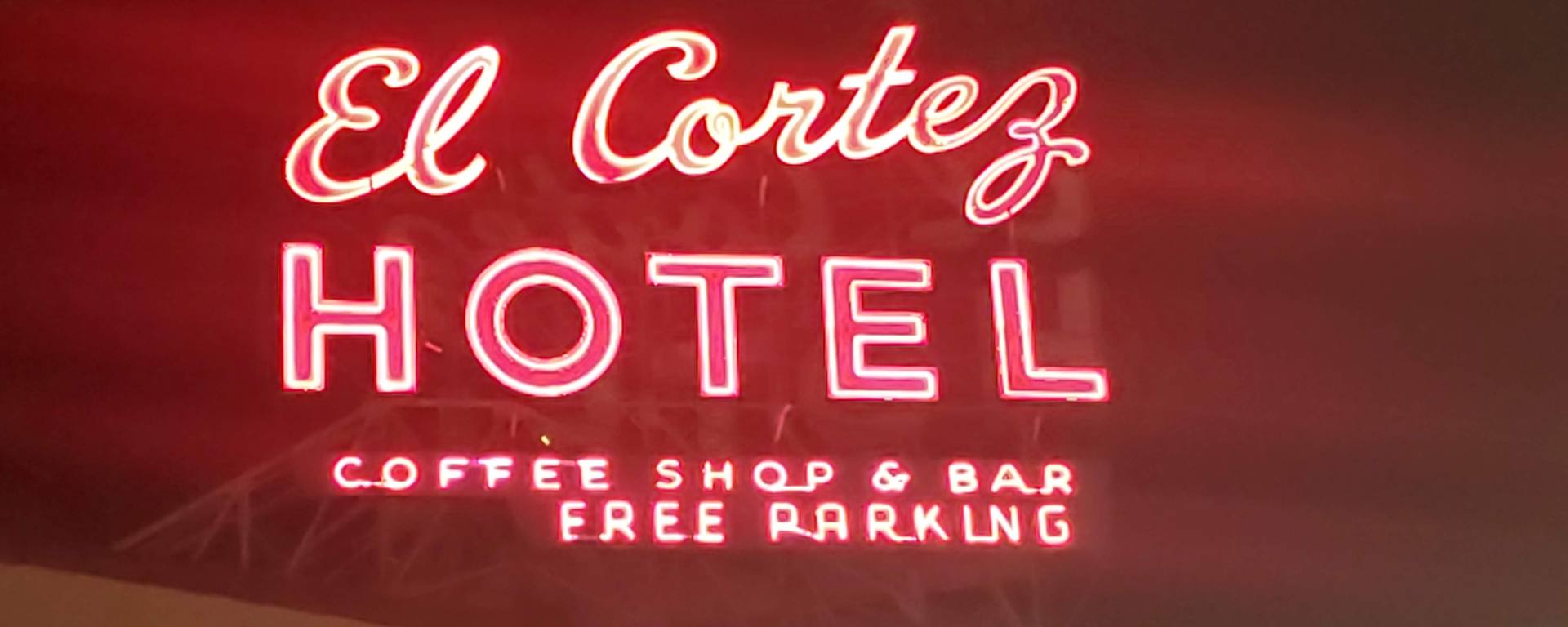
Part 1 of our El Cortez Spotlight series
Before Las Vegas had a skyline, it had a railroad stop, a few bars, and a stubborn belief that anything could grow in sand. The year was 1905, and the town existed mainly because trains needed a place to pause between Los Angeles and Salt Lake City. When the locomotives stopped, dust rose; when they left, silence returned. Men in stiff hats traded parcels of land like poker chips, already dreaming of electric lights that hadn’t been invented yet.
Fremont Street was the first to be paved, which made it, by default, the first place to matter. Its handful of saloons offered whiskey, faro, and shade. One newspaper described the town’s aesthetic as “a mixture of optimism and tin.” By the 1930s, the dam builders arrived – thousands of men with wages to burn and boredom to cure. They brought with them the raw material for a city: cash, vice, and the need to forget.
Vegas had always been a mirage that refused to vanish, but now it had a power source. When the Hoover Dam’s turbines began to hum, the neon signs followed like moths to a new kind of sun.
At the eastern end of Fremont, on a dusty corner that still smelled faintly of sage, a pair of developers – J. Kell Houssels Sr. and Marion Hicks – saw possibility. The Strip didn’t exist yet; the idea of a “resort corridor” was still as improbable as snow in July. But they imagined a hotel that would feel almost cosmopolitan, a gambler’s haven that could pretend to be sophisticated.
They called it El Cortez – “the courteous one.” Spanish, elegant, and just exotic enough for the tourists who would soon drive up from Los Angeles in new Fords, looking for legal sin and desert air. Construction began in 1940: 59 rooms, a modest casino, and an architectural style halfway between Spanish Colonial Revival and Hollywood fantasy. The total cost was $245,000 – an audacious sum for a town where the population could fit in a single movie theater.
When it opened in 1941, the local paper called El Cortez “the most luxurious hotel ever built in southern Nevada.” The phrase now sounds quaint, but at the time it meant tiled roofs, real linens, and a lobby with more chandeliers than lightbulbs. The dealers wore bow ties; the doorman had gloves. The hotel offered running water, air conditioning, and an unspoken promise that the desert was finally ready to behave.
The clientele were a curious mix: dam engineers, ranchers’ wives, soldiers on leave, a few businessmen who never said what business they were in. The casino had one craps table, a few blackjack setups, and a roulette wheel that squeaked when spun. The odds were generous, the drinks stronger, and the house band was a trio of locals who could play “In the Mood” on request, slightly off-key but always with heart.
Even then, El Cortez had a certain personality – a kind of quiet showmanship. Where other joints chased spectacle, it flirted with restraint. Hicks and Houssels believed gamblers preferred familiarity to grandeur, that they wanted a place where the dealers knew their names and the manager might comp a steak if you lost too badly. They were right.
The Strip’s first neon signs were still a decade away, but Fremont Street already glowed like a Christmas promise. The El Cortez sign – red letters stacked diagonally against the night – became one of the city’s earliest beacons. Locals said you could see it from the desert highway, blinking like a lighthouse for the reckless.
Of course, this was still the age before Las Vegas learned to polish its edges. Gunfights were rare but not impossible; cheating was more sport than scandal. The sheriff’s office doubled as the town’s moral compass, though it occasionally got lost. There was a rumor that the first casino license for El Cortez was signed over a poker game in the back of the Apache Hotel. The players agreed to keep the cards clean and the money local.
By 1945, the city had changed again. The war was ending, the soldiers were returning, and the mob – ever the early adopter – was sniffing opportunity. They saw in Vegas what no one else did: a place where the rules could be written in pencil. Bugsy Siegel, Meyer Lansky, Gus Greenbaum, and Moe Sedway arrived with a mix of East Coast polish and West Coast optimism. They bought El Cortez for $600,000 cash – a figure that still astonishes historians – and in doing so, they imported the myth of organized glamour.
Siegel didn’t stay long; the desert was too small for his ambitions. But for a few seasons, his suits walked the lobby, his bodyguards loitered by the slots, and his grin – half charm, half warning – became part of the décor. He used El Cortez as a prototype, an experiment in scale. Could Vegas support elegance and excess in the same building? The answer, of course, would arrive a few miles south, in the form of the Flamingo. But the blueprint began here.
The residents of Las Vegas watched all this with bemused pride. They liked to think of Fremont Street as the city’s living room – a little rough, a little cozy, perpetually awake. The El Cortez fit that mood perfectly. It was neither the richest nor the flashiest, but it had the virtue of being first. And in Vegas, being first is a kind of immortality.
By the end of the 1940s, the railroad town had become a constellation of neon. Fremont Street buzzed every night with a voltage that felt like destiny. Tourists drove in from California, parked their cars outside the El Cortez, and stepped into a world that promised something new: a place where the future wore a tuxedo and the past checked your coat.
What no one could have guessed was how long that promise would last – and how often it would need to be reinvented. But for a brief, golden stretch, before the Strip rose and the air filled with jet-fueled dreams, the heart of Las Vegas beat right here on Fremont Street, under the red sign of El Cortez, humming softly against the desert wind.

