
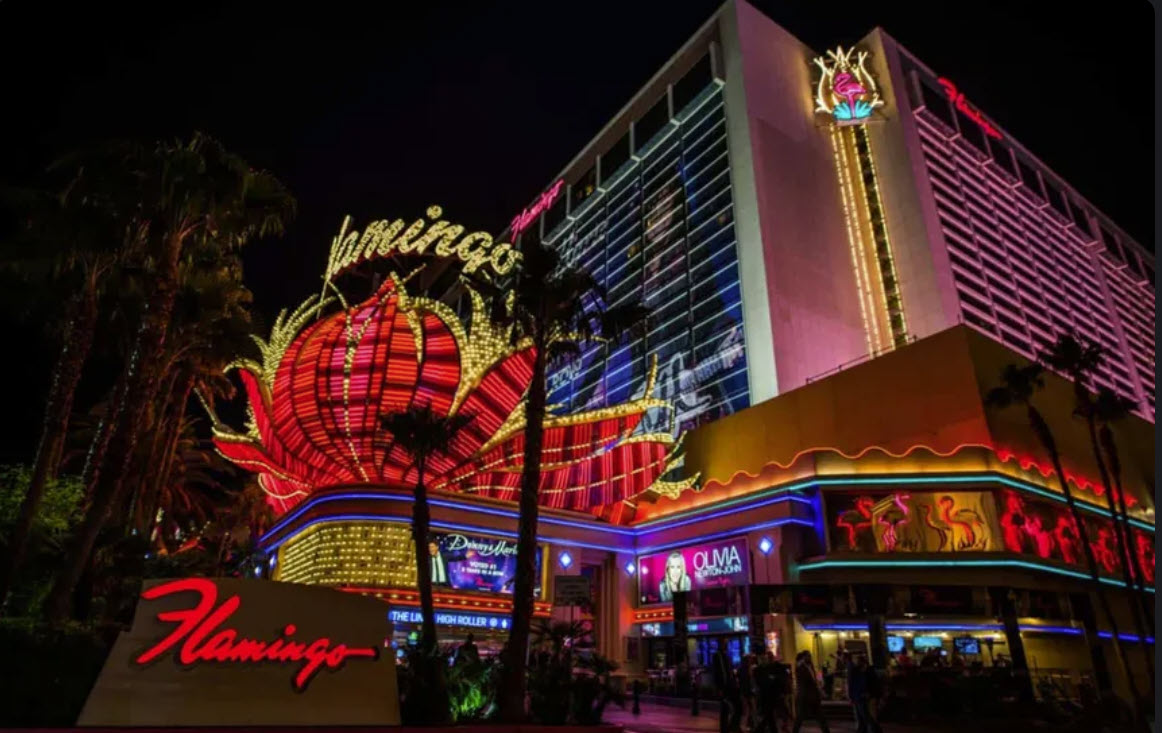
When the Flamingo Hotel and Casino opened its doors in 1946, it was more than just a new addition to the Las Vegas landscape—it was a game-changer. The Flamingo redefined what a casino could be, introducing an unprecedented level of luxury, entertainment, and branding to the desert oasis. Its success and impact would pave the way for the development of the Las Vegas Strip, influencing the design, marketing, and business model of future casinos and resorts.
A New Era of Luxury in Las Vegas
Before the Flamingo, Las Vegas casinos were largely modest gambling halls, catering to locals, small-time gamblers, and road-tripping tourists. Establishments like El Rancho Vegas and The Meadows had introduced resort-style amenities, but no one had envisioned anything on the scale of what Bugsy Siegel was planning.
Siegel, with backing from East Coast mobsters, set out to build a casino that was more than just a gambling hall—it was a destination. Inspired by Hollywood glamour, the Flamingo combined high-end accommodations, fine dining, and world-class entertainment in a way that had never been done before in Las Vegas. The hotel’s tropical theme, elegant design, and neon flamingo branding gave it a distinct identity, setting it apart from the Western and cowboy-themed casinos that had dominated Nevada until then.
The success of the Flamingo demonstrated that Las Vegas had the potential to be more than just a gambling stop—it could be an entertainment capital. This realization would spark a wave of development, as casino owners scrambled to compete with Siegel’s vision.
The Birth of the Modern Las Vegas Strip
The Flamingo’s success (and initial struggles) laid the groundwork for what would become the Las Vegas Strip, inspiring new resorts to embrace larger-than-life themes, entertainment, and luxury accommodations. One of the first major casinos to follow in its footsteps was the Sahara, which opened in 1952, featuring an upscale, desert oasis theme.
Soon after, the Sands Hotel and Casino launched in 1952, becoming a hotspot for Hollywood celebrities and high rollers—a business model directly influenced by the Flamingo’s ability to attract the elite. The Sands famously became the home of the Rat Pack, further reinforcing the idea that Las Vegas was more than just a gambler’s paradise—it was a place for A-list entertainment.
By the late 1950s and early 1960s, the Las Vegas Strip had evolved into a glittering wonderland of themed resorts, each striving to outdo the Flamingo in terms of size, luxury, and spectacle. Casinos like the Stardust and Caesars Palace took the Flamingo’s model and expanded on it, adding even more elaborate themes, entertainment, and attractions to draw in visitors.
The Flamingo’s Influence on Casino Entertainment
One of the Flamingo’s biggest contributions to Las Vegas was its emphasis on entertainment. Before its opening, most Vegas casinos focused primarily on gambling, with entertainment being a secondary feature. The Flamingo changed that by introducing headlining acts, dinner shows, and Hollywood-caliber performances as a core part of the experience.
This approach influenced resorts like the Riviera and The Dunes, which embraced high-profile entertainers to attract crowds. The concept reached new heights with the International Hotel (now Westgate Las Vegas), which hosted Elvis Presley for his legendary residency in 1969—an event that forever changed the Strip’s entertainment industry.
By the 1970s, Las Vegas had fully embraced spectacle-driven casino resorts, a trend that would continue with the mega-resorts of the 1990s and 2000s, such as the Bellagio, The Venetian, and MGM Grand.
Branding, Theming, and the Flamingo Effect
Another key aspect of the Flamingo’s influence was its approach to branding and theming. Before the Flamingo, casinos were largely functional gambling spaces with little focus on visual identity. Siegel’s Flamingo changed that by leaning into its theme, using tropical décor, pink neon, and flamingo imagery to create a cohesive brand.
This concept inspired later casinos to embrace theming as a marketing tool. The trend exploded in the 1990s, when Las Vegas saw a wave of massive themed resorts, including:
- Excalibur (Medieval Theme)
- Luxor (Ancient Egypt Theme)
- New York-New York (NYC Skyline Theme)
- Paris Las Vegas (French Theme)
Each of these resorts followed the Flamingo’s blueprint, creating immersive, fantasy-like experiences to differentiate themselves and attract a global audience.
The Flamingo’s Legacy on the Strip
Today, the Flamingo Hotel and Casino still stands as a testament to the vision that shaped Las Vegas. While it has undergone multiple renovations, its influence can be seen in every modern Las Vegas resort.
The Flamingo Effect—the idea that a casino should be more than just a gambling hall—set the Las Vegas Strip on a trajectory that transformed it into one of the most famous entertainment destinations in the world. Without the Flamingo’s groundbreaking model, the Las Vegas we know today might never have existed.
References:
Bugsy Siegel: The Mob Museum themobmuseum.org; History of the Flamingo: Caesars Entertainment caesars.com; Development of the Las Vegas Strip: Neon Museum Las Vegas neonmuseum.org; The Sands and Rat Pack Era: Las Vegas Sun lasvegassun.com; Evolution of Casino Entertainment: Smithsonian Magazine smithsonianmag.com.

